
Questions
Explore the most common questions people ask about the project. If something you’re curious about isn’t covered, you can send your question through at any time and our team will respond directly.
Community Questions
Project Details
Who is responsible for decommissioning the turbines and funding it?
The project owner is legally responsible for decommissioning the wind farm at the end of its operational life.
For more information, visit this page.
What is the expected height and lifespan of the turbines?
Turbine height and design are determined by site conditions and current technology standards, with an absolute maximum of 300m to the tip of the turbine. The typical operational lifespan is around 35 years, after which decommissioning or repowering may occur.
What happens at the end of the lifespan of the wind farm?
All infrastructure is removed at the end of the project’s life, apart from turbine foundations which would remain in the ground. Around 85% of a turbine is currently recyclable, and turbine manufacturers have committed to 100% recyclability by 2040. 2040 is before the end of the life of this project.
How many turbines are expected in this area?
The project area extends to Triangle Flat Road, which serves as the project’s boundary. A maximum of approximately 25 turbines is anticipated within this zone.
What is the projected power output per turbine?
Each turbine is expected to generate enough energy to power approximately 5,000 homes.
Environmental and Planning Considerations
What is the risk of vibration from operating turbines?
Operational turbines generate negligible ground vibration; no significant structural impact is expected.
How will vibration impacts be managed, especially near heritage buildings?
Construction-phase vibration studies will be conducted as part of the EIS. Heritage management plans will ensure adequate protection for listed historic structures. The NSW Government will assess both the EIS, and the Heritage management plan to ensure it will adequately protect listed heritage buildings.
The turbines proposed are larger than any others currently operating in Australia. How can you predict the noise that they will generate?
Prior to being installed for a project, a prototype will be installed, and noise levels from the turbines will be measured. This means that we know for sure, the noise output of the turbines before construction.
Are you aware of changes to Environmental Impact Statements going through Parliament and how this will change the process for assessing wind farm Development Applications?
We are not aware of any changes to the process for assessing wind farm Development Applications, but if proposed changes become law, we will follow those laws.
Do blocks with dwelling entitlements need to be taken into account for turbine setbacks?
Yes, dwelling entitlements need to be taken into account however, our program only provides payments for neighbouring dwellings.
How can you be confident that the project will comply with noise limits at my house?
The NSW Wind Farm Guidelines set some of the most stringent noise limits in the world. Under these guidelines and NSW Planning laws, wind farms must meet a noise limit of 35 dB at nearby homes, unless a landowner voluntarily agrees to a higher limit under a Neighbour Deed. Using detailed modelling, we can reliably predict how sound will travel across the landscape, giving us confidence that the project layout will comply with these limits at your house.
What are the minimum setback distances from dwellings?
Setbacks are guided by both visual and noise criteria in accordance with the New South Wales Wind Energy Guidelines. For a 300m tall turbine, the setback is 1.9km. However, it is more common for noise to be the determining criteria for setback. We expect that where there are multiple wind turbines, the project will be compliant from a noise perspective at around 2km.
The turbines proposed are larger than any others currently operating in Australia. How can you predict the noise that they will generate?
Before any turbine model is approved for use, a prototype is installed and independently tested to measure its actual noise levels. These real-world measurements give us a verified noise profile for the turbine well before construction begins, which means we can accurately predict how it will perform on site.
Why are water studies not yet finalised?
Water sourcing and usage are thoroughly investigated as part of the Environmental Impact Statement (EIS) process, which is currently in progress.
Where will the project source water for construction and operation?
Water resource studies are ongoing. Local water sources may be used if sustainable; otherwise, water will be trucked in. The project will not use streams directly for supply.
Grid and Technical Questions
Is lighting required for the wind turbines?
The requirement for aviation safety and lighting is determined by the Civil Aviation Safety Authority and the NSW Department of Planning, Infrastructure and Environment. Aviation safety risk is a key consideration in relation to local flight patterns and the proximity of proposed turbines to any airports. The Pines Wind Farm is not located near to any airports. CASA did not require lighting for the Golden Plains Wind Farm in Victoria and we understand that CASA has advised the Paling Yards Wind Farm (in development) that lighting would not be required. An aviation impact assessment will be completed to determine whether or not aviation safety lighting is required. In the case that lighting is required, this would likely be for turbines at the highest elevations, or at corners of the project. If required, any lighting on turbines would be the lowest intensity lighting possible. We understand that the community does not want lighting, and we will be doing all we can to avoid the need for aviation lighting.
Would an observatory be impacted by the project?
The project is liaising directly with local observatory operators to address and mitigate any potential electromagnetic interference, or visual interference.
When does the system convert from AC to DC power, and why isn’t the substation closer to the load centre?
Conversion occurs at designated substations, determined by grid infrastructure and technical requirements. Location decisions are based on efficiency and grid compatibility, but power is always being transferred as AC before it is exported to the existing power system.
What is the land take for a wind turbine?
A few hectares per turbine on average, including ancillary infrastructure such as access tracks.
How do wind turbines perform relative to solar energy given variable local wind conditions?
Wind conditions differ at turbine hub heights compared to ground level. Turbines operate effectively even when surface wind appears low, complementing solar generation patterns. At this project, we expect the majority of the generation to occur at night.
Where does the generated power go?
Electricity generated will be fed into the National Electricity Market (NEM) and distributed throughout the grid.
Safety and Risk Management
What processes exist to protect residents from infrasound and potential litigation?
The project’s agreements include provisions protecting host landholders from litigation arising from project operations.
How are biosecurity and land access managed?
All access to private land is negotiated with landholders. Biosecurity protocols will be established in collaboration with landowners to prevent contamination or disease transmission.
Who is liable if a fire is started by the wind farm?
In the very unlikely event that a fire is started by the wind farm, and that fire then makes it onto private property, the wind farm would be liable. The project will use safety in design concepts (such as fire breaks, strategic water storage removal of ladder fuels etc.) to reduce fire risk. The project also maintains insurance for such events.
What are the fire risks associated with turbines?
While turbine fire incidents are extremely rare (approximately 1 in 1,000 globally), risk mitigation includes lightning protection systems and adherence to fire safety regulations. Importantly lightning fires are the number one risk within the plantation right now, prior to the wind farm’s installation. We are confident that the fire risk will be lower when the project is built because of wind turbines safely grounding lightning strikes that may have otherwise started fires in the plantation.
Neighbour Agreements
What happens after 35 years when the project is decommissioned?
If the project is decommissioned, then neighbour deeds will automatically terminate.
Who funds payments to hosts and neighbours?
Payments are made by the project operator as part of its community and landholder engagement commitments. Payments are funded by the sale of electricity.
What happens if the project changes ownership?
Contractual obligations transfer with the project. All agreements include clauses ensuring landholder protections remain valid under new ownership.
When will revised contracts be released?
Within a week of the event (they have now been provided or are available if requested).
Why have neighbour deed offers changed?
Contracts have been updated directly in response to community feedback at our 10 nearby neighbour drop-in sessions. Revised contracts have now been shared, and anyone within 3.5km of a turbine can request one.
Transport and Infrastructure
Which transport routes will be used?
Transport routes are under assessment. Past projects used the Mid-Western Highway and nearby quarries for road materials. Final routes will be confirmed in the Traffic Management Plan (TMP).
Will local roads be used for heavy transport?
Where feasible, internal access roads will be prioritised. Use of public roads will be subject to council and community consultation. The project will be planned to minimise travel distances during construction. Where public roads are damaged, the project will commit to maintaining them, both during and at the end of construction.
When will the TMP be publicly available?
The TMP will be released as part of the EIS documentation once finalised.
How will waste be managed during construction?
A detailed Waste Management Plan will form part of the Construction Environmental Management Plan (CEMP), ensuring compliance with environmental standards. We also understand that waste management, water management, accommodation are major topics for local Councils. We will work closely with local councils on these topics so that we can create an EIS that does not put undue pressure on council facilities.
Additional Questions
Will the project expand further west in the future?
No. The boundary along Triangle Flat Road is firm.
Is there a minimum number of turbines required for project viability?
Yes, a minimum generation threshold is required for commercial feasibility, though specific figures depend on final design and financial modelling. From a commercial perspective, we are confident that the project is large enough to be viable.
What alternatives are being considered for the O’Connell Road route?
There are several routes under investigation. When a route is selected, we will announce it.
How many workers will the project employ, and where will they live?
Workforce requirements for the project are still being finalised, but construction is expected to peak at around 250-350 workers. To support this, a range of accommodation options are being explored, including the implementation our affordable housing project. One of the other options being considered is purpose-built worker accommodation. For The Pines Wind Farm, we are aiming to design this accommodation so it can deliver a lasting legacy for the community, potentially becoming a future nursing home, school camp, or another community facility once construction is complete.
Ask your question
Our team will respond directly to answer your questions.
FAQ
The planning and approvals phase
How will you manage environmental concerns?
As part of the development and approvals process a series of surveys and assessments will be undertaken. The surveys are to determine the potential impact on the local environment. The results of these surveys will be used in the design process to help us to avoid and minimise impacts. Environmental management plans will then be prepared to manage impacts through construction and operations.
What are we doing now?
We have commenced the Planning and Approvals phase of the project. The approvals process for the project is expected to take 3 - 5 years. During this time, we will be undertaking detailed studies including traffic and transport, fire risk management, visual impact, noise, ecology and cultural heritage.
How will the project be assessed?
The project will be assessed by the Department of Planning, Housing and Infrastructure. In 2025 we will commence the Environmental Impact Assessment process, throughout this time we will continue to engage with the community and seek feedback as the project progresses.
The project
Where is the proposed project?
The Investigations Permit Area includes Gurnang State Forest, part of Mount David State Forest, and some parts of Vulcan State Forest south of Black Springs. The investigation area is limited to the State's softwood plantations; no native forests are included.
Will the project be on freehold land?
The Pines Wind Farm wants to share the benefits of the project with the community, one way to do this is to offer the opportunity to host project infrastructure on land surrounding the investigations area. Project infrastructure could include wind turbines, transmission infrastructure and laydown areas. Participation as a host is optional, The Pines Wind Farm does not have any compulsory acquisition powers and cannot force landowners to host infrastructure.
Will the proposed project be in other parts of the forest?
No. The Planning and Investigation Permit issued by Forestry Corporation of NSW is limited to the areas named above, we are not permitted to investigate any other State Forests not named in the Permit. No native forests are included in the investigations permit.
The draft layout
Will I still be able to use the forest for recreation activities?
During the investigations and planning and approvals phases there will be no impact on the use of the forest by the community or visitors to the region. Forestry Corporation of NSW will continue to issue permits for recreation activities. As part of the Community Benefits Package, we will be exploring ways to improve recreational facilities in the forests we are operating in. This may include upgrades to facilities and parking areas and access roads. During construction, for the safety of forest visitors, some areas may have restricted access. Once the wind farm is operational however, it is business as usual for Forest visitors.
Do I have to sign an NDA?
The Pines Wind Farm team will never ask you to sign an Non Disclosure Agreement, we are committed to open, honest and transparent communications with the community on the impacts and opportunities of the proposal.
Will the proposed project be visible from Oberon?
All proposed wind turbines would be more than 15km from Oberon. At this distance, the visual impact is anticipated to be low, pending a detailed assessment by a visual impact consultant.
Will I be able to hear the wind farm?
At 1.5km distance from the wind turbine base it is likely that the sound pressure level from an operating wind turbine will be around 35 decibels. 35 decibel is the noise limit outlined in the NSW wind energy guidelines that aims to ensure noise levels do not significantly affect the living experience of people residing in the area. It can be seen in the graphic below that NSW has amongst the most-stringent noise requirements in the world. Most people hear a soft woosh-woosh noise at this distance if there is very low background noise around them. As the project progresses, noise studies will be undertaken to determine the background noise levels and the potential noise levels at neighbouring dwellings.

How big will the wind turbines be?
The technology for the proposed project is yet to be finalised, it is expected however that the turbines will be approximately 300m tall at the top of the blade tip.
Why wasn't the layout released sooner?
We were not able to release a draft layout earlier as we needed to understand the locations of private dwellings. Due to the excellent response from nearby neighbours and the community, we have been able to release this draft layout for discussion.
What will the project look like from my house?
If you would like to see what the project could look like from your property, we have augmented reality software that we can use to show you. The TrueView program overlays the draft wind turbine layout on the landscape, this is then viewed through an iPad from different locations on your property. If you would like to have a demonstration you can request a meeting.
What is the purpose of the draft layout?
The purpose of sharing the first draft layout is for consultation, providing neighbours to the investigation area and the community with an indication of:
- the scale of the project and likely turbine spacing
- what wind turbines could look like from neighbouring houses and/or different public locations
- what it might mean for neighbours, both in terms of impacts and benefits such as the Nearby Neighbour Program.
How did you determine the number of wind turbines?
To create the draft layout, we have assumed a 1.5km setback from neighbouring dwellings. In our experience this is the most commonly accepted set back. This is a draft layout for discussion, these setbacks will likely change as further neighbour feedback is incorporated into the design.
How many wind turbines will there be?
The draft layout shows approximately 250 wind turbines within the investigation area. There is a lot of interest from neighbouring landowners to participate in the project either by hosting or the nearby neighbour program, The Pines Wind Farm team will continue engaging with these landowners which may result in the project growing over time.
Participating in the project
How can I participate?
Neighbours to the investigation area are able to participate in the project by:
- joining the nearby neighbour program
- hosting project infrastructure including wind turbines, laydown areas, access tracks and transmission infrastructure.
What is the timing for including freehold land?
Freehold host landowners will be included in the Scoping Report, to be submitted to NSW Department of Planning, Housing and Infrastructure (NSW DPHI).
The Nearby Neighbour Program closed 31 December 2025.
Proposed project benefits
Will you have neighbour payments?
A Nearby Neighbour Program will be established as part of the Community Benefits Package. The Nearby Neighbour Program will include budget for annual payments to neighbours within 3.5km of wind turbines. Further information on this can be found on the Neighbours page.
I live nearby, how can I benefit?
We will be engaging with those closest to the project about opportunities for participation. We are also looking to speak with private landholders about joining our Nearby Neighbour Program for neighbours within 3.5km. To discuss involvement please contact us.
Is there a community benefits package?
A Community Benefits Package will be established for the project worth at least $1,050 per MW per annum. The package includes a Community Benefit Fund, a Nearby Neighbour Program and contributions to the local council. The final size of the proposed project will be determined during the planning and approvals phase, through consultation with the local community.
Insurance
I am considering hosting project infrastructure or turbines on my property; will this affect my property or public liability insurance?
No. Hosting of infrastructure or turbines on your property is managed through a lease agreement. The Pines Wind Farm lease agreements will include:
- annual lease payments
- coverage as an additional insured under the project's insurance policy. This means a host is covered if they accidentally cause damage to the wind farm
- periodic fire safety assessments of your property
I own a property/operate a business in Oberon, will The Pines Wind Farm affect my property or public liability insurance?
No. A variety of factors go into the calculation of Insurance premiums including claims history, business practices, cost of capital etc. We can see no reason why the presence of The Pines Wind Farm, more than 15km away, would introduce a relevant risk to properties in the Oberon LGA.
I own a property/operate a business very close to The Pines Wind Farm investigation area, will this affect my property or public liability insurance?
No. We have found no evidence supporting an increase in premiums due to the proximity of a wind farm. However, to ensure this does not become an issue in the future we have extended our neighbour benefit program to include insurance. Neighbours within 3.5km of a wind turbine have the opportunity to enter into neighbour benefit agreements. The agreements provide:
- annual neighbour payments based on proximity to turbines
- coverage as an additional insured under the project's insurance policy. This means a neighbour is covered if they accidentally cause damage to the wind farm
- periodic fire safety assessments of their property
Does Australia's peak industry body for Insurance think that renewables cause rising premiums?
No. In a statement to the ABC, the Insurance Council of Australia has said: “The rising cost of cover has nothing to do with renewables. Premiums are rising because of escalating costs of natural disasters, the increasing value of homes and vehicles making them more expensive to replace, and inflation pushing up building and vehicle repair costs."
Fire safety
What about lightning strikes?
Wind turbines are designed with lightning protection systems that draw lightning strikes safely to ground without injury to people or property. According to the CSIRO, lightning strike is the most common cause of bushfires. The height of wind turbines, coupled with these lightning protection systems substantially reduce the chance of lightning strike on trees, fences and buildings in the area around the wind farm.
What happens in a bush fire?
A bushfire risk assessment is undertaken for each project and a bushfire management plan will be prepared and made available to the community. The management plan includes details of water tanks and other firefighting equipment maintained at the wind farm site, and how the wind farm personnel and equipment will assist firefighting efforts in case of bushfires in the region.The wind turbines to be used on the project are fitted with advanced smoke detection and fire suppression systems. When smoke is detected, a signal is sent to the operator who will immediately shut down the turbine and alert the fire authority.The suppression system will activate in the event of fire, a gas suppressant is released to extinguish any fire, the types of gas used are environmentally safe and act to cool the fire and remove oxygen to extinguish flames.
Will there be a higher risk of fires because of the wind farm?
If it proceeds, The Pines Wind Farm will potentially lower the risk of fire in and around the region.
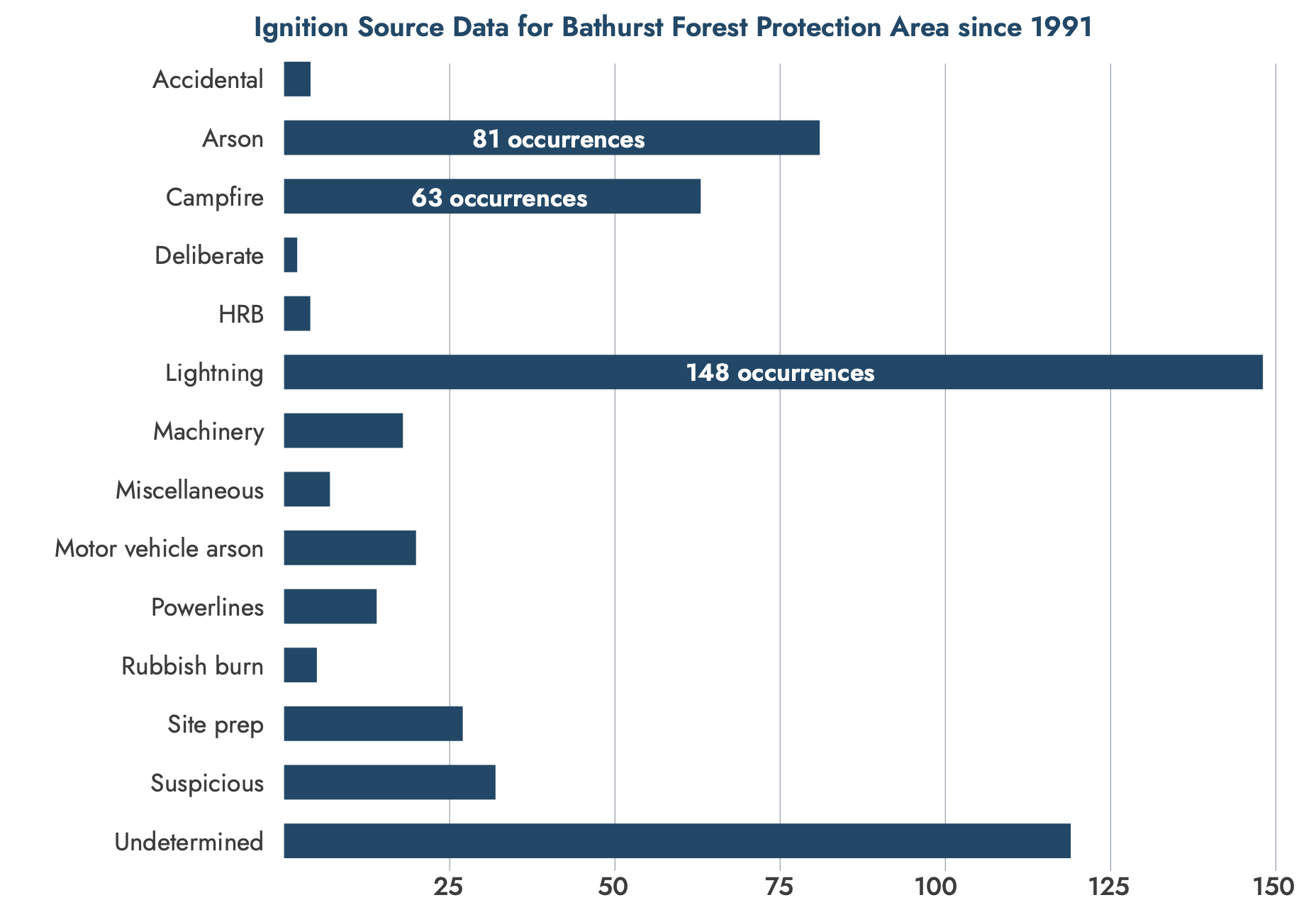
Forestry Corporation of NSW keeps records of ignition sources for forest fires. Over the last 33 years, the three biggest identified sources of ignition are lightning, arson and campfire.
As explained below, The Pines Wind Farm will potentially help reduce the risk of all three of these fire sources.
Wind turbines reduce the risk of lightning fires
Lightning strikes are frequent around elevated regions like Oberon and if they strike flammable objects, can start fires. Over the last 33 years, lightning has been the most common cause of fire identified in State Forests.Wind turbines are designed to conduct lightning strikes safely into the earth mat underground around the base of the turbine.
Due to their height, wind turbines naturally attract lightning, substantially lowering the occurrences of lighting strikes on flammable objects such as trees and fences.
The Pines Wind Farm Proposal includes turbines certified to IEC 61400-24 (lightning protection), that ensures all wind turbines will have engineered lightning protection systems to international standards.
24-hour operations and surveillance
Early detection and 24-hour manned surveillance will reduce fire risks from campfires and arson, improving security across the plantations.
The Pines Wind Farm Proposal includes 24-hour operations and surveillance, including a network of security cameras, and will feed into a 24-hour manned control centre.
The Pines Wind Farm Proposal would result in the construction of a $3bn dollar power generation asset for NSW feeding the National Electricity Market (NEM). This asset would be operated and monitored 24 hours a day, seven days a week for its 35-year operational life. The proposed monitoring will include a network of security cameras and other equipment for the early detection of forest fires. The 24-hour manned control centre will have a fire plan and direct communication with Forestry Corporation of NSW and other fire authorities.
Wind farms
Where can I find more information?
The project website will be updated with new information as it becomes available. You can also sign up for the project newsletter. We will be hosting a series of community engagement sessions throughout the project investigations and planning and approvals phases as well.
Are wind turbines really environmentally friendly? How long does a turbine take to repay the carbon it takes to produce it?
Vestas, the world’s leading wind turbine manufacturer, has calculated the operating times that wind turbines need to generate in order to payback the energy used in their manufacture. These times vary from 5 months for high wind sites (like The Pines Wind Farm) out to 8 months for lower wind speed sites. For comparison, solar photovoltaic panels are 1 to 2 years and hydro-electric power plants are 9 to 13 months on the same metric.You can read more about this on the Vestas website: vestas.com/en/sustainability/environment/energy-payback
What about reflections from the turbines causing glare?
This is known as blade glint. Blade glint can be produced by the reflection of the sun’s light from smooth and reflective surfaces. Modern wind turbine blades are coated with non-reflective paint, to prevent the occurrence of blade glint.
How do wind farms generate electricity?
Wind flows over the blades like air flowing over an aeroplane wing. This flow of air causes a difference in air pressure between the front and back of the blade, moving the blades forward and making the rotor spin. The spinning rotor drives a generator, converting motion into electricity to export to the grid.
What is shadow flicker?
Wind turbines and their blades can cast shadows on nearby land. When viewed from a stationary position, the blade’s moving shadows appear to flicker, giving rise to the term ‘shadow flicker’.Wind energy guidelines limit the shadow flicker experienced at any neighbouring dwelling to an average 30 hours per year as a result of the operation of the wind farm. An assessment of shadow flicker will be undertaken as part of the Environmental Impact Assessment process to ensure The Pines Wind Farm is compliant with guidelines.
Ask your question
Our team will respond directly to answer your questions.